
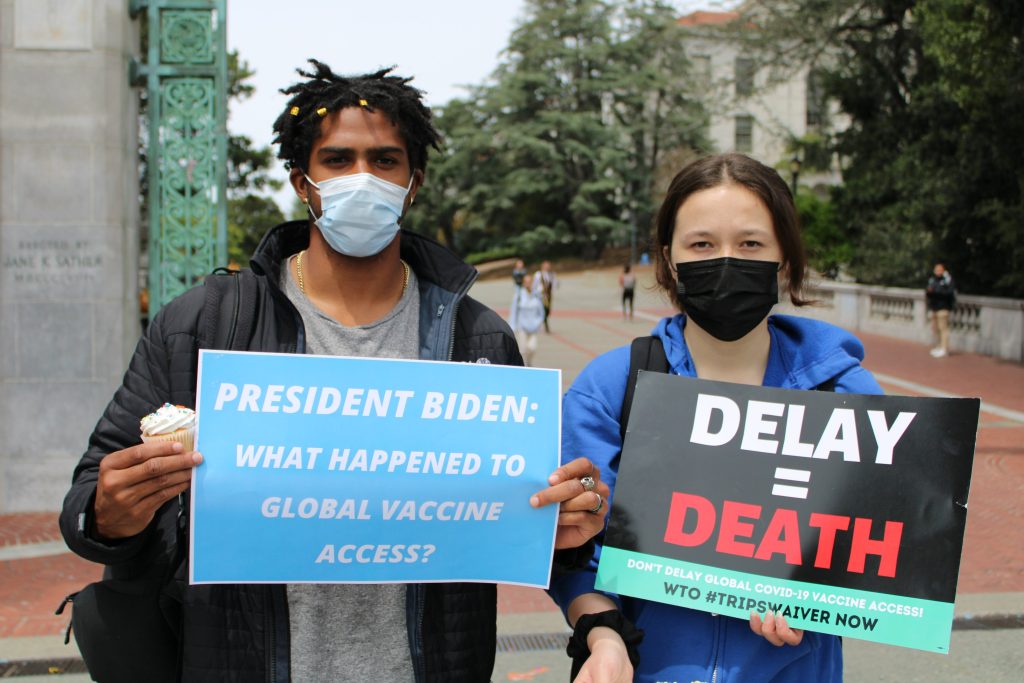
Billions of people in low- and middle-income countries worldwide still don’t have access to the COVID-19 vaccines, tests and treatments that many Americans take for granted. This ongoing inequality is contributing to thousands of avoidable deaths each day, and is responsible for the COVID variants that are prolonging hardships for everyone.
This fall, the Biden administration and other governments will be making major policy decisions about whether to support expanding global access to COVID tests and treatments — or whether to maintain the status quo levels of inaccess that have proven highly profitable for pharmaceutical monopolies.
Students and others across the country will be taking action the week of October 3–7 to help build demand for the Biden administration to support partner demands on this issue immediately prior to a key World Trade Organization meeting. Please join us!
Proposed Week of Action Activities
Monday, October 3: Global Test and Treatment Access Student Activist Briefing
Tuesday, October 4: Campus Day of Education
Wednesday, October 5: Global Test and Treatments Letter Writing Day
Thursday, October 6: Rallies for Global Access to Test and Treatments
Friday, October 7: Global Twitter Storm for COVID Test and Treatment Action
Background on Global Demands for Access to COVID Medicines
On October 2, 2020, the governments of India and South Africa — eventually backed by over 100 other nations — proposed temporarily waiving parts of the World Trade Organization’s (WTO’s) Agreement on Trade-Related Aspects of Intellectual Property Rights (TRIPS) in order to make it easier for COVID-19 vaccines, tests and treatments to be produced in as many places as possible as quickly as possible.
This “TRIPS waiver” demand came as Global North nations hoarded COVID medical technologies, pharmaceutical companies intentionally limited the quantity of doses being produced, and low- and middle-income countries throughout the world thus often went without. Two years later, billions of people around the world still don’t have access to basic COVID medicines. The COVID-19 death toll is currently four times higher in lower-income countries.
Campaigning by activists in the U.S. and across the globe eventually convinced President Biden to voice his support for a TRIPS waiver — but the text that was eventually approved by the WTO in June 2022 proved far too limited to actually expand access. That said, during its General Council Meeting on October 7, the WTO will be considering demands to strengthen access to COVID diagnostics and therapeutics. These basic technologies are the cornerstone of any “test and treat” public health strategy for dealing with COVID-19, and less affluent nations must no longer be required to go without.
Public health advocates, human rights groups, faith organizations, labor unions and many, many others are calling on the Biden administration to do two things this fall: (1) support demands by South Africa, India, and others to lift WTO barriers standing in the way of global access to COVID tests and treatments; and (2) voice support for countries’ right to use compulsory licenses to produce COVID medicines.
To that latter point, health advocates in Peru, Colombia, Chile, the Dominican Republic and elsewhere have been attempting to get their governments to issue compulsory licenses for the generic production of the COVID treatment Paxlovid. Traditionally, the U.S. government has sided with Big Pharma in pressuring countries not to issue compulsory licenses. If President Biden were to voice his support for the practice, many believe other nations would have considerably less apprehension about issuing the licenses needed to produce generic versions of Paxlovid and other COVID medicines.